
Kittens grow quickly, but a fixed “one pound per month” table is not a reliable target across kittenhood. Research from US veterinary records uses separate growth curves by sex and follows the kitten's path across centiles rather than assigning one correct weight to each month. Breed, sex, neuter status, starting size and body condition all affect the pattern.
Published kitten growth chart
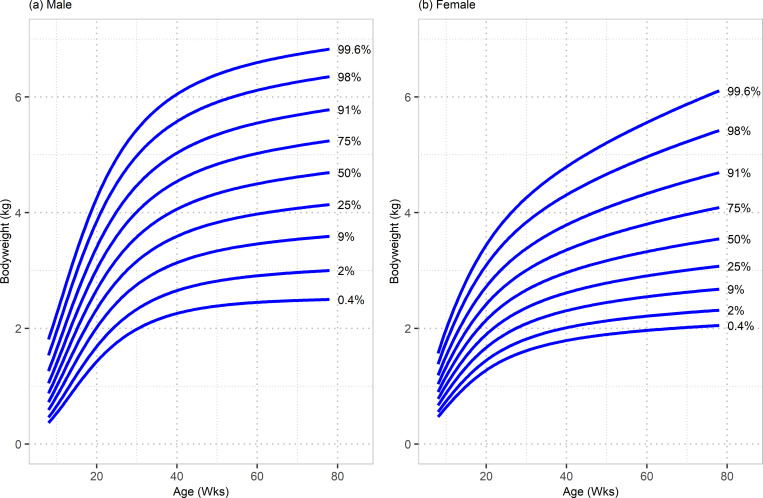
Male and female growth centiles for intact domestic shorthair kittens in US veterinary records, reproduced from Salt et al., PLOS ONE (2022), Figure 1, under CC BY 4.0. The source image and data are unchanged.
The horizontal axis is age in weeks and the vertical axis is bodyweight in kilograms. Find the sex-specific panel, plot each measured weight at the kitten's age, and look at the path across repeated visits. The curves do not provide a diagnosis, and they should not be applied as a target for neutered kittens, pedigree breeds, or kittens outside the study population without veterinary interpretation.
How to read a kitten growth chart
| Chart feature | What it can show | Important limit | |---|---|---| | Repeated weights | Whether the kitten keeps a broadly consistent trajectory | One weight cannot establish a growth pattern | | Sex-specific centiles | Comparison with a reference population of the same sex | The published US curves were developed for intact domestic shorthair kittens | | Crossing centile lines | A change worth discussing with a veterinary professional | It does not identify the cause or diagnose under- or overweight | | Body and muscle condition | Context for what the scale number represents | Adult BCS tools are not a substitute for kitten growth assessment |
Published curves describe populations, not a promise of what one kitten should weigh. A veterinarian can select and interpret an appropriate chart while considering the kitten's history and physical examination.
How to track a kitten properly
- Weigh weekly, same scale, same time of day. A kitchen scale works well for small kittens.
- Record every weigh-in with the date — the pattern across weeks is the useful part.
- Look at the trajectory, not a single reading. A marked change in direction or repeated movement across centile lines is useful information to bring to your veterinarian.
- Note appetite, energy and litter box habits alongside weight — numbers plus behavior tell the story.
The PetsLately Weight Tracker keeps this log for you and shows the mathematical change between weigh-ins to share with your vet.
When to contact your vet promptly
- The trend flattens, drops, or changes direction unexpectedly
- Repeated measurements move markedly away from the kitten's previous trajectory
- Your kitten eats poorly, has diarrhea, vomits, or seems lethargic
- A very young kitten is not gaining as your veterinary or foster-care team expected
Kittens have small reserves — with a kitten, it's always reasonable to call your vet sooner rather than later.
This guide describes typical growth patterns. It does not set a target weight or predict adult size for your kitten — your vet tracks growth with you at each visit.